Have you caught yourself wondering whether ceramic coated cookware is a good option for you?
Here’s my experience, safety tips, and best practices to help you make the right choice.
For me, choosing ceramic, was a win!
Note:
This post contains affiliate links, which means, at no cost to you, I may earn a commission if you make a purchase through these links. Please note that I only recommend products that I personally use and believe will add value to my followers. I was an Amazon addict long before I became a blogger!
As an Amazon Associate, I earn from qualifying purchases.
My Story
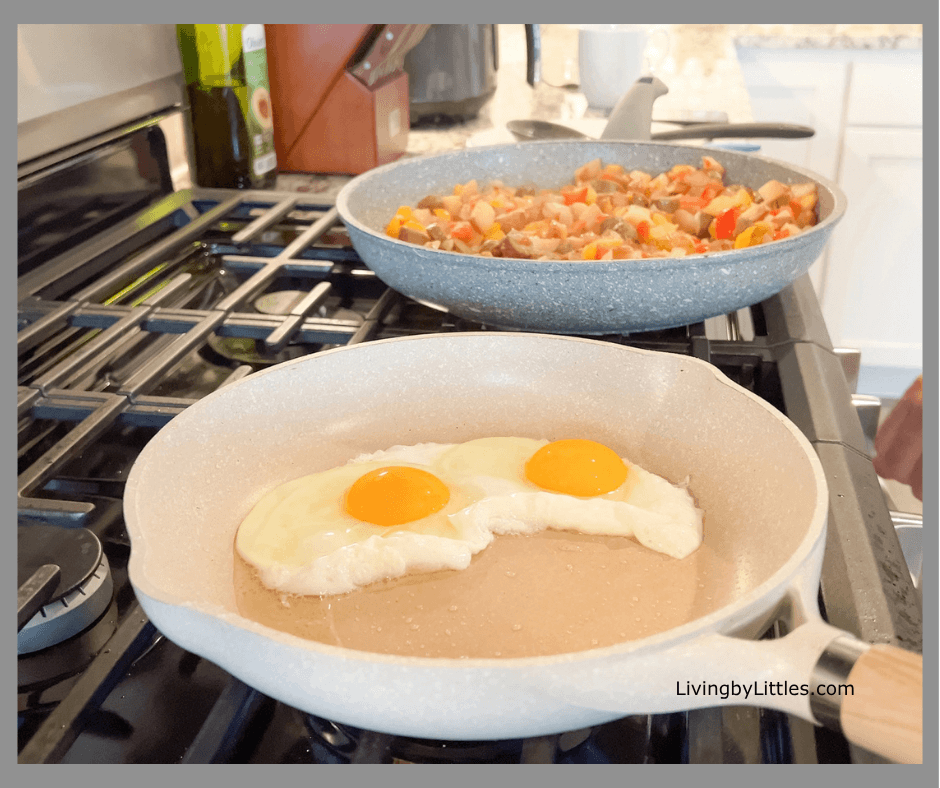
Eggs are my main go-to for breakfast.
Whether they are over-easy, scrambled, or omelets, eggs are a breakfast staple for us.
For years, I made our eggs using a traditional non-stick skillet.
Right up until the coating started coming off with the egg.
At that point, I had to rethink my pan of choice.
My initial choice was good old cast iron. While cast iron is amazing for many kinds of cooking situations, frying eggs (in my experience) isn’t one of them.
What I was on the hunt for was a good nonstick skillet I could feel good about using.
After much searching, I decided to give the ceramic coated, non-stick option a try.
Without hesitation, I can say it was a win!
So much so that, after witnessing my hassle-free egg making, three friends have purchased their own ceramic skillets.
So, if you’re looking for nonstick cookware you can live with, my new go to is ceramic.
However, if you’re like me, you have questions.
Allow me to save you some legwork and answer some of the questions I initially had.
What is Ceramic Cookware?
When I began my search, I set out to purchase a 100% small ceramic skillet.
While it exists, 100% ceramic cookware is less widely available and much more expensive than nonstick ceramic coated cookware (the 8” skillet I coveted was over a hundred dollars!)
Most nonstick ceramic cookware is made using a metal core, usually aluminum, stainless steel, or cast-iron, and coated with a thin ceramic coating.
The price difference was my deciding factor in choosing ceramic coated.
Once I understood that most ceramic cookware is actually ceramic coated, I needed to know if it was indeed better than traditional nonstick options.
Traditional vs Ceramic Coated Non-Stick
Inquiring minds need to know; what’s the difference between traditional and ceramic nonstick skillets?
While both traditional and nonstick ceramic skillets are both coatings for a core metal pan, the difference is in the composition of the coating.
Traditional Nonstick
Traditional nonstick pans are coated with polytetrafluoroethylene (PTFE), a synthetic polymer that creates an extremely slick glass-like surface (commonly known as Teflon)
Ceramic Nonstick
Ceramic Nonstick pans are made using a liquid sol-gel process derived from inorganic silica or beach sand.
When translated means: The process starts with a liquid mixture (sol) made from tiny particles of silica (the same mineral found in beach sand)
As it dries and cures that liquid is transformed into a solid, glass-like layer (“gel”).
What this means for you is that the coating of ceramic cookware is made from minerals rather than plastics or traditional nonstick materials.
Safety
Is ceramic-coated cookware safe?
Here’s the honest truth: after all my digging, I couldn’t find a single source willing to claim that ceramic‑coated cookware is absolutely safe in every circumstance.
AND no one goes on record saying it’s safer than traditional nonstick options.
Safety really comes down to a few practical things — the quality of the pan, how you use it, and the condition it’s in over time.
For me, the process and the materials feel sound enough that I’m comfortable using ceramic‑coated cookware for the everyday purposes for which I purchased it.
But if you only feel at ease with cookware that’s one‑hundred‑percent safe under any and every condition, you’re better off sticking with cast iron, fully ceramic pieces, or options with no coating at all.
Best Practices
Since the quality of the pan largely influences safety, there are some best practices for caring for ceramic coated cookware.
Cooking Best Practices
Use low to medium heat when cooking.
I didn’t purchase my ceramic skillet to be a kitchen workhorse. I needed a safe nonstick skillet in which to make eggs.
Over time, prolonged high temperatures can damage the finish.
Use a small amount of oil or butter when heating.
Although they are labeled “nonstick”, a small amount of butter or oil protects the coating.
Do not use aerosol nonstick spray. Aerosol nonstick sprays contain additives that bake onto the ceramic ruining the finish.
Instead opt for a small pat of butter or invest in a good refillable container.
My ceramic skillet and spray bottle go hand in hand in my kitchen.
Utensils
No metal utensils!
Instead, opt for silicon, plastic or wooden utensils for stirring and flipping.
Care Best Practices
Hand Wash Only!
If you can’t bear the thought of handwashing, don’t buy ceramic cookware.
Even if the label states “dishwasher safe” there’s a risk that the high temperature water and abrasive soaps will ruin the delicate finish.
To date, my skillet has only needed to be gently wiped for everything to wipe right out.
No Abrasive Cleaners
Stay away from steel wool, and any kind of abrasive cleaner.
If the cookware does have something burned on, opt for a good overnight soak instead of a full out scrub down.
Replace
If the finish cracks, chips, or peels, it’s time for a replacement.
I’ve had my skillet for close to a year and so far, no cracks, chips, or peels.
Final Thoughts
So, if you’re ready to retire your traditional nonstick cookware, a ceramic coated option is definitely worth considering.
Keep in mind it isn’t a heavy-duty, do everything pan, but for those simple everyday cooking tasks, it’s a definite win.
And if my experience is any indication, you might just find yourself recommending it to friends.
AND A LITTLE MORE!
Find it on Amazon!
Sensarte Nonstick Ceramic Frying Pan with Lid
Micki’s Little Letter!
Sign Up For Micki’s Little Letter
Not sure you want to sign up?