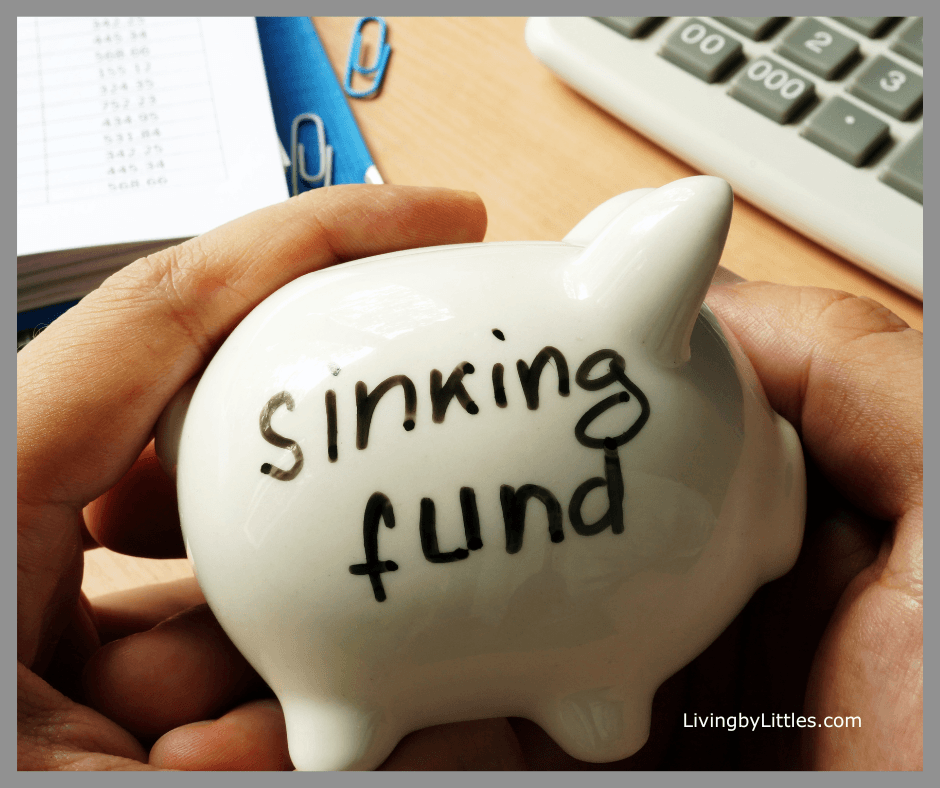
Do big ticket expenses tend to sink your financial ship?
Stop the madness and start using sinking funds to shore up your personal financial plan.
Sinking funds turn saving for everything from medical bills to destination vacations into achievable goals.
Dare I say that sinking funds can actually make saving fun?
My Story
I have always been an advocate of Christmas Clubs.
But for far too long, it never occurred to me to extend that concept to other kinds of large expenses.
At some point I ran across the term “sinking fund”. A bit of internet sleuthing led me to understand that a sinking fund is basically a Christmas Club established for any and every kind of expense for which you want to save.
What a budget-changing concept.
It’s a term, and practice, I wish I could have understood and started years ago.
Sinking Funds
What Are They?
If you understand what a savings account is, you already understand the idea behind a sinking fund.
A traditional savings account is typically used to set aside money for unexpected or emergency expenses. There is no predetermined point at which the funds will be spent.
A sinking fund, however, is a savings account with a specific purpose. You intentionally save toward a known future expense, and once you reach the target amount, you spend it as planned.
How Do They Work?
Let’s say you know that in about a year you will need new tires.
You expect the tires to cost approximately eight hundred dollars.
Instead of waiting a year and having the eight-hundred-dollar expense sink your well-meaning budget, you establish a sinking fund for tires.
Throughout the year, you make small, regular deposits.
Ideally, they are part of your zero-based budget, and the funds are transferred based on when you get paid.
At the end of the year, you have saved eight hundred dollars, you make the withdrawal and pay cash for the tires.
Congratulations! Your budget has not been sunk by the expense of new tires.
What an awesome feeling.
What Kinds of Expenses?
If an expense has the potential to do serious damage to your budget, it’s a candidate for a sinking fund.
Here’s just a few examples:
- Medical and dental expenses
- Vacations
- Yearly taxes
- Vehicle expenses
The list is limited only by your imagination and financial needs.
Important! Use Separate Accounts
Mixing funds will lead to confusion and eventually defeat the purpose.
Establish each sinking fund as its own separate account.
However, there’s no need to open a new savings account for every sinking fund.
Most banks and credit unions offer sub-accounts, or an equivalent.
Sub accounts are just secondary accounts associated with a primary account.
Capital One calls these accounts Savings Buckets and you can have up to thirty of them associated with one primary savings account.
Contact your financial institution to learn how to open their version of a sub account.
Fun Fact
The term “sinking fund” originated in 18th century Britain as a financial strategy to “sink” massive debt incurred from fighting foreign wars.
Over time, the concept made its way into corporate finance, and most recently, into the jargon of personal finance.
However, in personal finance, instead of it being a strategy to pay down debt, a sinking fund is a savings strategy, thus avoiding the need to incur debt to begin with.
Do big ticket items tend to sink your financial ship?
Big‑ticket expenses don’t have to sink your financial ship.
You can stay afloat — calmly, confidently — by building sinking funds before those costs roll in. Start now, start small, and let future‑you breathe a sigh of relief.
********************
WHAT IS MICKI’S LITTLE LETTER?
********************